


How a simple, machine-verifiable address attestation standard can strengthen interoperability and security across institutional digital asset markets.
The digital asset industry is steadily progressing through the same stages of maturity seen in other financial infrastructures. As institutional participation grows, common frameworks naturally emerge around compliance, communication, operating models, and market conventions.
This evolution is already visible in areas such as Travel Rule compliance, industry identification schemes, regulatory interpretations, and communication frameworks. It is often a sign that a market has reached meaningful scale.
Custody is no exception. As banks, custodians, brokers, exchanges, and infrastructure providers interact more frequently, shared standards help reduce friction, improve interoperability, and create a common operating basis for new institutional relationships.
Yet one area stands apart. Address sharing is not simply another operational process to standardize; it is a security-sensitive assurance challenge. It is a trust and cybersecurity challenge.
Why Address Sharing Is Different
Many standards are designed to improve efficiency. Address attestation serves a more sensitive purpose: building confidence in the information that precedes asset movement.
Whenever one institution transfers digital assets to another, the receiving address must first be communicated. At first glance, this appears straightforward: one party provides an address, and the other party sends assets to it.
In reality, this exchange sits at one of the most security-sensitive points in the custody lifecycle: it is the moment when operational information directly determines the movement of assets.
If compliance information is incomplete, institutions can pause, investigate, and request what is missing. If a destination address has been substituted by an attacker, the consequences are different: assets may be sent to an unintended recipient, and recovery may be difficult or impossible.
The challenge is not the blockchain itself, but the reliability of the information exchanged before a transfer takes place. Institutions need to know that:
- The address genuinely originated from the intended counterparty.
- The information has not been altered.
- The address remains valid for the intended purpose.
- The receiving institution stands behind the information provided.
This places address sharing at a critical boundary between institutions, making it fundamentally different from many other standardization efforts.
Effective Controls Exist but They Remain Bilateral
The industry has not ignored this challenge. Over the years, custodians and other market participants have developed a variety of safeguards to reduce operational and security risks surrounding address exchange, including extensive counterparty onboarding, callback procedures, reliance on secure communication channels like SWIFT, proprietary portals, manual validation workflows, and internal approval processes.
These mechanisms are generally effective, but operationally intensive. The challenge is that each institution applies them differently. As networks expand and new relationships form, confidence increasingly depends on a patchwork of bespoke procedures that becomes harder to scale.
The result is not insecurity. It is fragmentation. The challenge is therefore not to replace existing controls, but to create a shared layer of trust that can operate across them.
A Lesson from Financial Market Infrastructure
Financial markets have faced similar challenges before. The success of systems such as SWIFT demonstrates the value of common frameworks for exchanging information between institutions. Yet history also provides an important lesson: communication standards and message standards are not the same thing.
A communication network enables participants to exchange information; a message standard defines what information should be exchanged and how it should be interpreted.
Even mature industries continue to refine and adapt message usage to specific business needs. Perfect standardization is rarely achieved simply by defining a communication channel.
The most successful standards tend to focus on clearly defined problems with clearly defined outcomes. They are often narrower in scope than initially expected.
Address attestation may represent precisely this type of opportunity: a focused standard that addresses a specific trust challenge without attempting to standardize every aspect of institutional digital asset operations.
What Is an Address Attestation?
In simple terms, an address attestation is a digitally signed statement asserting that a particular blockchain address is controlled by a particular institution and may be used for a specified purpose.
The address itself is only part of the message. Depending on industry consensus, additional information might include:
- Institutional identity: who issued the attestation
- Intended recipients: who should rely on it
- Validity periods: when the attestation expires or should no longer be used
- Supported assets: which asset types can be sent to the address safely, such as ETH and ERC-20s, but other tokens could become unrecoverable
- Operational limits: intended usage parameters, such as suitability for routine transfers but not high-value settlement flows
- Contact information: a path for operational escalation
The precise schema is ultimately a topic for industry discussion. What matters most is industry consensus around the structure, so the information can become machine-verifiable.
Rather than relying on emails, PDFs, screenshots, spreadsheets, or manually maintained records, institutions gain a structured mechanism for expressing and validating information. A recipient should be able to verify who issued an attestation, confirm that it has not been altered, determine whether it remains valid, and establish whether it was intended for them.
The underlying idea is straightforward. Critical transfer information should not depend solely on manual review and operational processes. It should be expressed in a form that can be verified consistently by both people and systems.
Keeping the Standard Small Is a Feature
Standards discussions often become ambitious very quickly. Once participants gather around a table, it is tempting to expand the scope to cover adjacent problems, additional workflows, and broader interoperability goals.
There is merit in these conversations. The digital asset industry undoubtedly requires continued standardization across multiple domains.
Address attestation, however, benefits from remaining intentionally narrow. The goal is not to standardize custody operations in general, settlement workflows, compliance information exchange, or transaction orchestration. It is far simpler: to create a common way to validate destination information.
That focus is a strength. Narrowly scoped standards are easier to understand, implement, and govern. Just as importantly, they are more likely to achieve broad industry adoption.
The most impactful standards are often not the largest ones. They are the ones that solve a fundamental problem well enough that everyone adopts them.
From Manual Checks to Systematic Verification
Current custody operations rely heavily on experienced professionals following well-designed procedures. That will not change, nor should it. Human oversight remains an essential component of institutional security.
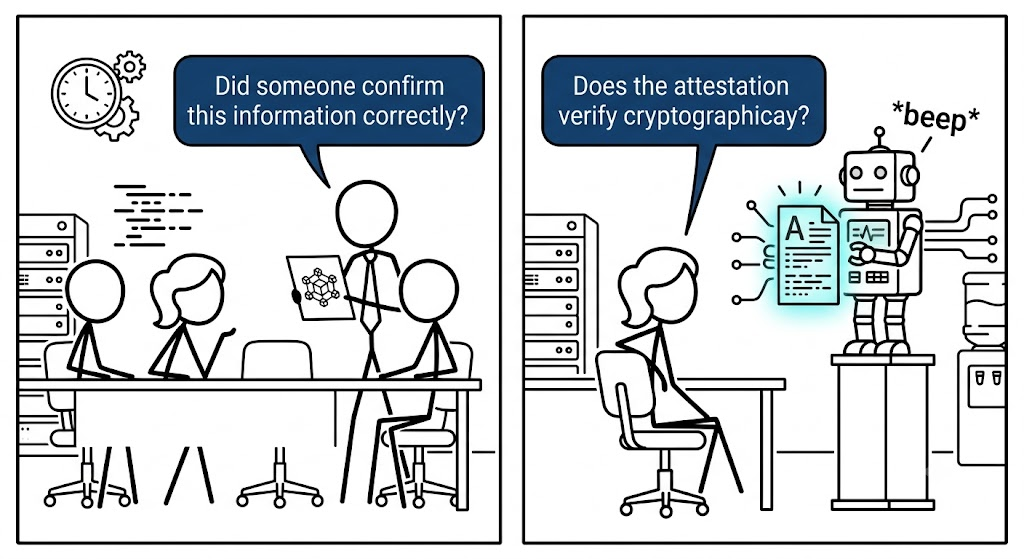
At the same time, digital signatures and structured attestations make it possible to shift certain checks from manual review toward systematic verification.
This shift improves consistency, auditability, automation, and scalability across institutional networks. More importantly, it strengthens assurance at one of the most security-sensitive points in the transfer process. In an industry built on trust, information that underpins asset transfers should be expressed in a form that systems can verify as reliably as people can.
A Practical Next Step for Institutional Digital Assets
The digital asset industry will continue to develop standards across many areas. That progress is both healthy and necessary.
Address attestation stands out because it addresses a particularly fundamental question: how institutions establish confidence in destination information before assets move.
A common, machine-verifiable address attestation format will not solve every interoperability challenge, nor should it try to. Its purpose is more focused: providing a shared mechanism for validating information at one of the most security-sensitive points in the transfer process.
As institutional networks expand, reliance on institution-specific processes becomes increasingly difficult to scale. The industry already has ways to move digital assets; what it increasingly needs is a more consistent and verifiable way to establish confidence before movement occurs.
A practical, security-focused address attestation standard offers a path toward that goal. Not by replacing existing controls, but by giving institutions a common and verifiable basis for one of the most important pieces of information exchanged before a transfer takes place.
Crypto Finance is actively working with industry participants to advance discussion around a common address attestation standard. Institutions interested in contributing to the development of a practical, interoperable approach to address trust are invited to get in touch at: research@crypto-finance.com